
Table of Contents
Growing up, confidence wasn’t what I was known for. My sister on the hand… one would question we were even related (if it weren’t for the nose, that is). Being around her, I associated confidence with extroversion, an unfaltering eloquence, and being unapologetically opinionated (in the nicest possible way sis).
Now that half my life has been lived, I realise that while those qualities may appear as byproducts, confidence is more of a quiet feeling within us, made of different forms of:
- self-acceptance
- curiosity
- conviction
- resilience
The thing with self-confidence is that it’s deeply intricate. My intention here is not to teach you to ‘suck eggs’ or reveal its secret as though it were a magic pill. I’m simply sharing ideas I’ve tried myself. Every day practises we often overlook and some perspectives that genuinely shifted my thinking.
1. Own your current confidence

You might not feel confident overall, but you are confident in certain areas of your life — even if you haven’t realised it.
There may be things you’ve learnt to do with ease that make others shrivel into a nervous wreck. For example:
- Organising meals for your family
- Driving
- Playing with your kids
- Speaking openly to your partner
- Maintaining your appearance
- Carrying out your job
- Empathising with others
These are not small things. Each deed is evidence of confidence in action.
I was neither confident nor competent at driving till the wholesome age of 41!
But when I look back at my childhood years on the other hand, I realise I cultivated self-confidence after all, in a family environment where I often felt misunderstood. I had to trust my own mind, and hold onto a sense of self without much validation.
That early recognition of my individuality helped me carve my own path. I’d fight off comparisons that often engulfed me, shoo away labels that tried so hard to stick, and embrace my own inner voice.

It takes effort, a good dose of self-pity and some outrageous tactics, but it goes to show, your circumstances do not always dictate your inner strength.
In short: Recognise what you are already confident in — even if it’s small.
2. Ditch the vagueness and get specific.
Once you acknowledge where you are confident, it becomes easier to see where you want to improve. Instead of saying:
“I’m not a confident person.”
get specific:
- “I struggle to speak up in meetings without first wanting to hide under the table.”
- “I’m scared to host, in case I make a buffet of dips nobody eats.”
- “I’m not confident I can run 5K without wanting to lie down after 5 minutes”
- “I hesitate to wear ‘that’ outfit – the one that makes me cringe and take it off at lightning speed.
If the problem is vague, it feels personal — like a flaw.
If the problem is specific, it becomes a thing you can amend or practise.

In short: Naming the micro-problem stops you from attacking yourself.
3. Allow yourself to be you.
Nichola Jane Hobbs, author of The Relaxed Woman, encourages us to give ourselves permission to be seen as we really are. She says:
“When we stop trying to prove our worth, we start to feel it.”
Working in a hospital, for years, I had seen the stress managerial roles brought to otherwise fairly chilled people. Even though I’d stepped in and led successfully many times, I didn’t think pursuing the role permanently at that time in my life, was for me. But when I saw my friends landing these jobs, it niggled at me and my confidence. I guess I was caught up in the comparison battle. But you know what they say? Comparison is the thief of joy.
The moment I paused and gave myself permission to be who I truly was:
- a hands-on mum
- creatively curious
- appreciated in a clinical role
- grateful for a less stressful workload
…I realised I had nothing to feel inferior about. I was simply growing in different ways, following a different trajectory on a different timeline. And the minute I accepted that, my confidence improved. I no longer needed to prove myself and felt happier leading my life, my way.

In short: Allow yourself to be seen as you are, in all your glory.
4. Awkard? Good. Means you’re alive!

Jennifer Lawrence isn’t known for perfection — she’s known for being real. Her confidence comes from embracing, not avoiding awkwardness.
Not everyone can laugh off embarrassment so freely, some would rather disappear down a man hole. But there are ways to soften its intensity:
- Name what your body is doing.
“My cheeks are flushing and that’s natural – my body’s just protecting me – redness and all.” - Acknowledge the moment.
“My brain had a glitch — let’s start again, and maybe once more. - Remember the Spotlight Effect.
People are far, far, too busy thinking about themselves to remember your misstep. - Turn it into a story.
“This will be funny later,” interrupts the spiral of shame. And who doesn’t want a funny story up their sleeve? - Do small “awkward reps.”
- Stand still in a shop with no purpose (me on a regular basis, not by choice)
- Ask someone to repeat themselves (preferably just the once).
- Sit without your phone in a café. Yes, you heard that right.
These small exposures teach your nervous system that being seen is safe.
I do some of these regularly. It’s not about fixing your personality — it’s about:
- Taking the edge off the panic
- Understanding your body is just reacting, not betraying you
- Seeing awkward moments as normal
- Getting used to discomfort a tiny bit at a time
None of this requires extroversion.
In short: Acknowledge the awkward moment, breathe, continue.
5. Find where you flourish
Some environments shrink us. Some expand us.
If certain people or situations make your confidence dip, spend more time around those who make you feel free — even briefly. A class, a colleague, a friend, a family member. These spaces help your inner confidence grow.
Growing up, I didn’t feel free to express myself at home — but at school, I did. I could be the class clown, the aspiring writer, the singer – unashamedly belting out The Bangles at inappropriate moments! That environment allowed my confidence to sprout.

In short: Spend time where you feel free.
6. Curiosity won’t kill you. It’ll save you.
Einstein said:
“I have no special talents. I am only passionately curious.”
Curiosity removes pressure. It shifts:
“Will I succeed?”
to
“I wonder what will happen if I try this?”
This makes every challenge feel exploratory rather than high-stakes.

A while ago, I submitted a children’s picture book manuscript to an agent just for a laugh. Of course I was rejected. But staying curious helped me handle the rejection calmly, led me to research and further hone my skills.
In short: Curiosity counteracts perfectionism. Use it.
7. Do the scary thing your heart keeps nagging you about.
Fear doesn’t mean “don’t do it.” It means it matters.
Growing up, I was an early developer and insecure about my body. Yet for some inexplicable reason I chose to sprint 200m on sports day, even though my bust had a mind of its own. I tried out for the netball team even though everyone towered over me picking fluff from my hair. And I got back into writing, even with time restraints and fewer brain cells. Scary times – but worth the thrill.
When you do something scared, your brain links that action to meaning, purpose, and growth; with that, confidence rises.

In short: Remember your why, and do it anyway.
8. Lighten the load
As Tom Phillips writes in Humans — A Brief History of How We F*cked It All Up:
“We thrive not through perfection, but through relentless trial and error.”
Everyone is winging it if you think about it.
If you put too much pressure on yourself, you may experience the three Rs.
- React harshly to your mistakes
- Regret your response
- Retreat from yourself and others
Confidence plummets when pressure dominates. Go easier on yourself.
Richard L. Franklin writes in The Mythology of Self Worth that confidence doesn’t come from doing things well — but from doing them at all.
You can only become the best at something once you’ve allowed yourself to get better at it first.

In short: When the pressure becomes too much, pause, zoom out and regain perspective.
9. Fake it with flair.
“Fake it till you make it” can help — but only when balanced with real passion and awareness.
At university, I met a guitarist and we wrote songs together. When we started off playing at three minute open mic nights, waiting a lifetime to get on the damn stage, my confidence needed some work. But once I had started pretending I was in an established band, I’d worn the clothes, belted out the songs and treated every open mic like it was an intimate gig.
This belief, gave way to forming a proper band with drums and everything! We enthusiastically played low paid gigs across pubs in London and even though we were complete amateurs my confidence grew.
But of course, it’s when something goes awry -that’s the true reflection of your confidence. The self -doubt suddenly comes banging at your door, desperate to be heard. Insecurities you thought you’d neatly folded up into a miniscule dot, reappear, all singing, all dancing, with bells on. So very annoying!
This is because your faking may have led you to believe you are confident on the outer layer, but deep down, you may be too far removed from the facts.

When I started a hospital job with brand-new equipment and no training, I tried to fake confidence instead of asking for help — and it nearly broke me.
But staying self-aware meant the three Ts.
- Truth: I admitted I needed support.
- Trust: I recognised the areas I could excel in.
- Treatment: I learnt to treat myself with more kindness and acceptance.
In short: Act like the person you want to become whilst staying true to your values.
10. Stack up small wins.
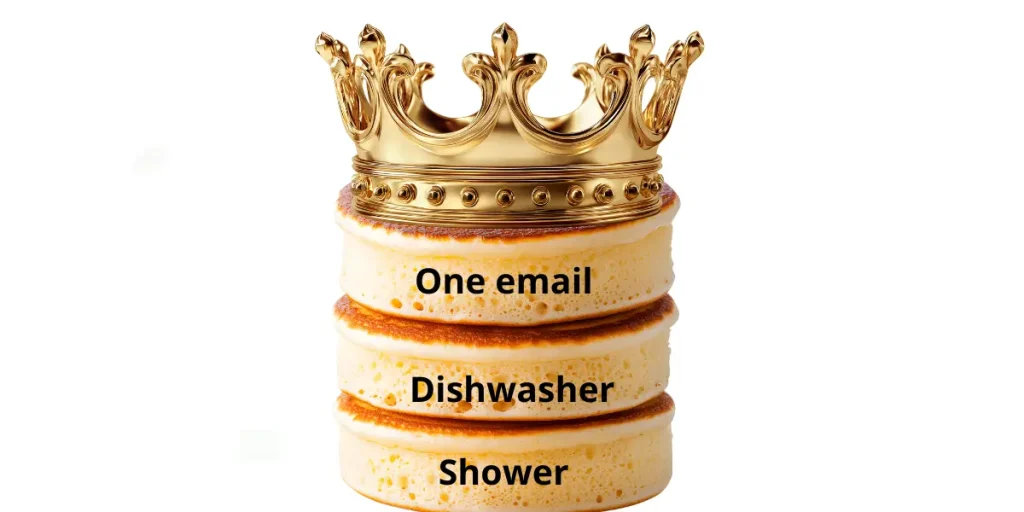
Say what you intend to do — then do it.
- I will have a shower – do it.
- I will load the dishwasher – do it.
- I will reply to one email – do it.
My son now says his next action out loud to help him complete it — and the effect is noticeable. It works because each time you follow through on something, it tells your brain, “I can rely on myself.”
In short: Keeping small promises equates to self-trust.
11. Upgrade your language

I’ve stopped using the word ‘just’ in my work emails. Instant self-confidence.
For instance, “I’m just organising a staff meeting” can sound weak and devalues the intent. Now replace with “I’m organising a staff meeting”. Boom! You communicate with conviction.
How about when you speak to yourself? I’m known to call myself a div. Because I can be sometimes and it’s pretty harmless.
But if I’m truly dwelling over something I have or haven ‘t done, after a short moment of bashing my head with an invisible saucepan, I create another me. The logical, counsellor me. The person who’s going to get me off the ‘wallow hollow’ with a gentle shove. Help me through the ‘door of feelings’ out onto the other side. Better explained in my article ‘Self-care. What self-care?’
By speaking to myself in a more constructive, objective way, as if I am my own friendly shrink, I get through things.
Other ways to reframe language would be to skip the cheesy affirmations “I am unstoppable!”. Use grounded statements instead:
- “I’m learning to handle this.”
- “I don’t need to be perfect; just willing.”
- “This is data, not disappointment.”
These statements tell your nervous system: we’re safe, we’re capable, we can adapt.
And that’s when confidence naturally grows. Not from ego, but from realistic internal reassurances.
In short: Re-word your inner dialogue as if you were caring for a close friend.
12. Wear it and walk it like you mean it.
Wardrobe isn’t everything, but it plays a big role in self-confidence. The way you dress sends quiet signals to yourself as much as to the world about how you feel, what you value, and how you want to appear.
When you throw on something that’s tattered or feels shoddy, it has a way of shrinking your energy without your realising. But when you choose pieces that fit well, feel good, and reflect a better version of you, your posture changes and your mood lifts. It doesn’t need to be glamorous; it just needs to make you feel capable and reflect your inner strength. A jacket, a belt you like or an unusual brooch.

Personally, I’m a chronic shirt-tucker – it instantly makes me feel sharper, even if I do get carried away and tuck my jumper too.
What about the way you carry yourself? An open posture is basically nature’s built-in confidence boost. Stand upright and you instantly look like someone who knows where they’re going — or at least someone who isn’t apologising for taking up space in this world.
When I was younger, my back curved into such a stoop, I got nicknamed ‘question mark’. Simply outstanding, in more ways than one.
But the moment you stop folding yourself into a human pretzel, your energy lifts instead of collapsing inward.
Here’s what happens when you open up your stance:
- Lifting your chin makes you more likely to smile or nod.
- Those tiny interactions with people and your surroundings pull you back into the present.
- And being present quietens the mental noise, reminding you that you’re safe, grounded, and capable.
In short: Your clothes and posture are an extension of yourself. Feel good about them.
13. Prepare just enough, to shake off your inner doubt.
Have you ever met someone who speaks with such certainty that even when you challenge them, they barely flinch? They simply know what they’re saying and they hold their ground.

I used to be the opposite by default (but getting better). Even when I knew I was right, doubt would slip in the moment someone challenged me. And honestly, it usually came down to one thing: preparation.
When you know your topic, when you’ve thought through some likely questions and when you’ve done the research beforehand, confidence stops being something you have to muster – it becomes the natural byproduct of being well informed.
Self -doubt still tries to creep in sometimes. Recently I taught a colleague a very technical process. I knew my stuff, but when questioned, I could feel the old self-doubt trying to gnaw at me. Although I successfully shook it off, it re-instilled something important: preparation doesn’t just help you be right. It helps you feel right when in the moment. And that feeling makes all the difference when you’re trying to show up with confidence.
In short: Preparation stops perspiration!
The bottom line: Confidence is a relationship, not an attribute
We often believe confidence is a quality that’s stitched into a person’s DNA. But real confidence is a relationship — between your awareness, your trust, and your ability to empower yourself in small, impactful ways.
Practising the above thirteen approaches helps you realise, confidence isn’t about having all the answers. It’s about knowing you’ll be OK while you find them. And trust me, we’re all searching for them, in one way or another.